Editor's note: This article is based on a September 2026 public report by Shenzhen Bao'an Traditional Chinese Medicine Hospital Group; the medical history and treatment course are presented as described in that report. This is not a ShanghaiMed patient case. We use it to introduce how TCM traumatology approaches chronic joint problems in older adults — including what it can and cannot do. One patient's experience does not represent typical results.
If you've watched a parent or grandparent deal with chronic knee pain, you know how difficult the treatment conversation can become. Pain medication, physical therapy, injections and joint replacement each have a place; the right choice depends on the patient's joint damage, general health, goals and surgical risk.
According to the hospital's published account, a 93-year-old Chinese-Canadian woman I'll call Mrs. Li had been living with pain in both knees. The report mentions that joint replacement and pain medication had been among the options discussed during her earlier care in Canada. Because she was reluctant to undergo surgery, she later chose to explore conservative TCM traumatology care in Shenzhen.
In July 2026, she travelled to Shenzhen for an assessment at a TCM hospital.
Why she sought another opinion
For someone in their nineties, both surgery and conservative care have their place. The decision should take account of joint damage, underlying conditions, anaesthetic and surgical risk, rehabilitation support and personal goals. Choosing conservative care should not mean simply enduring uncontrolled pain.
Mrs. Li subsequently consulted a TCM traumatology team — the branch of Chinese medicine focused on bone, joint and soft-tissue conditions — to explore whether a structured non-surgical programme was appropriate for her. The account below describes what the hospital reported; it does not mean that another patient would have the same result with the same approach.
The treatment process described in the report
On July 17, 2026, Mrs. Li arrived at the traumatology department of Shenzhen Bao'an Traditional Chinese Medicine Hospital Group in a wheelchair. She was received by Dr. Qiu Hongtao, an associate chief TCM physician and sixth-generation inheritor of the Shi-style Traumatology (石氏伤科) tradition — a nationally recognised intangible cultural heritage technique originally developed in Shanghai.
Because of Mrs. Li's hearing difficulty, Dr. Qiu sat with her for an extended first consultation, writing questions and answers back and forth on paper. The page filled up with her medical history in Canada, previous treatments, years of pain progression, and a thorough TCM examination including pulse and tongue diagnosis.
The TCM pattern diagnosis reported by the hospital was knee bi syndrome (膝痹), liver-kidney deficiency with phlegm-stasis obstructing the collaterals. This is a TCM description of the patient's overall presentation and knee condition; it cannot be mapped directly onto a modern medical diagnosis or pathological mechanism.
Her team designed a combined internal-and-external approach:
Internal herbal medicine: According to the report, the prescription was based on the Shi-style traumatology formula Niubangzi Tang, combined with a modified Jiming San. Herbal prescriptions should be individually prepared by a qualified clinician after considering the patient's constitution, condition and other medications. Acupuncture — three methods combined:- Shi-style Ashi-point oblique needling (阿是穴斜刺法), the signature national-heritage technique: the physician palpates around the knee to locate rope-like bands of soft tissue described as "tendon knots," then inserts fine needles obliquely along the muscle-fibre direction. The report describes this technique as being used to release soft-tissue tension and ease pain.
- Dry needling used to stimulate myofascial trigger points around the knee and relax tense muscle bands.
- Fu's subcutaneous needling (浮针), a shallow technique performed at the fascial layer, described in the report as being used to release fascial tension and improve local discomfort.
Changes described in the report
According to the hospital's report, after the first treatment session Mrs. Li's knee swelling decreased, her pain eased, her range of motion improved, and her morning stiffness became shorter.
The hospital described the following progress later in her treatment:
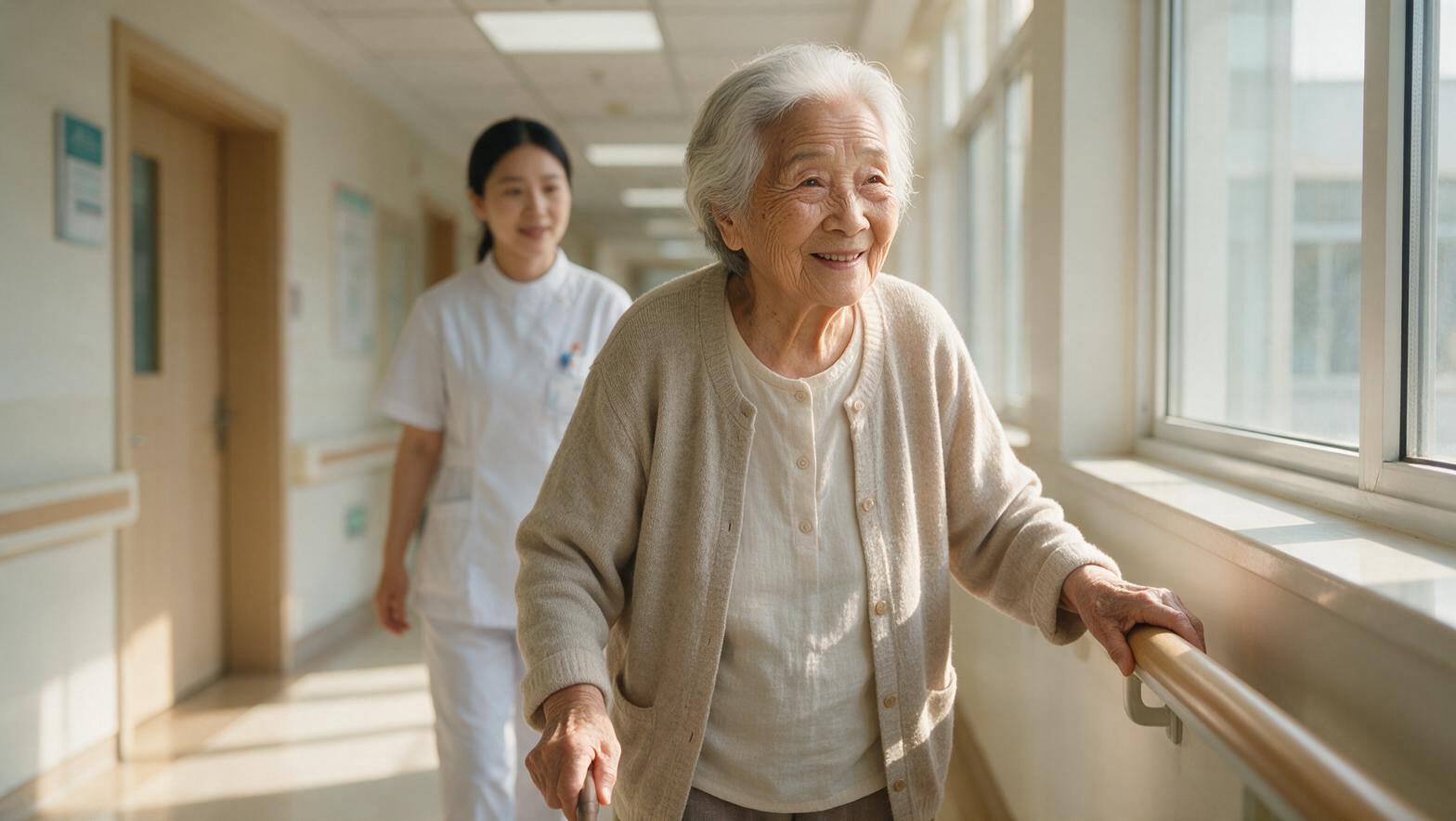
Mrs. Li, who had needed a wheelchair on arrival, was reportedly able to walk from her bed to the door and along the hospital corridor. This describes a change in everyday short-distance walking, not high-intensity activity, and does not establish the long-term outcome.
She was discharged on August 7, 2026. Her family came to the hospital with four silk banners and a thank-you letter — a traditional Chinese way of expressing gratitude to a medical team.
She told Dr. Qiu, "You saved my life."
He wrote back on paper: "I just did what a doctor should do. You being well is the greatest reward for me."
How to interpret this case
When reading an individual case like this, several points need to be clear:
Why it matters for international patients
For international patients considering treatment in China — whether in Shanghai, Shenzhen or elsewhere — this story offers a practical window into TCM traumatology (中医骨伤科):
TCM traumatology is not just acupuncture. It may include herbal medicine, manual therapy, specialised needling techniques, external herbal applications and exercise rehabilitation. In some departments, conservative care sits alongside Western orthopaedic assessment and surgical referral. The appropriate pathway should be determined by qualified clinicians after establishing the diagnosis.
Shi-style Traumatology, the tradition used in Mrs. Li's case, originated in Shanghai in the late Qing dynasty and is now recognised as a national intangible cultural heritage technique. Shanghai is home to major Grade 3A TCM and integrated-medicine hospitals with traumatology departments, including Longhua Hospital and Shuguang Hospital affiliated with Shanghai University of TCM. If you specifically want Shi-style care, the individual physician's training and departmental background should be verified rather than assumed from the hospital name alone.
For older adults who want to understand conservative options before major surgery; for patients with chronic musculoskeletal pain that has not responded sufficiently to physical therapy, injections or medication; and for patients who want to integrate TCM approaches into post-surgical rehabilitation — TCM traumatology can be an option to discuss and assess further with qualified clinicians.
When TCM is appropriate — and when it isn't
Patients commonly seek a TCM traumatology opinion for:
- Chronic osteoarthritis pain (knee, hip, shoulder, neck or back) when they want to understand conservative options before surgery;
- Musculoskeletal pain (such as plantar fasciitis, tennis elbow, frozen shoulder, cervical or lumbar pain) that has not improved sufficiently with standard conservative care;
- Post-surgical rehabilitation, where acupuncture, tuina or other therapies may be used as adjuncts for symptom management and rehabilitation;
- Recovery from some soft-tissue sports injuries.
TCM is not the right first stop for:
- Acute trauma (fractures, dislocations, complete ligament ruptures);
- Progressive neurological symptoms (cauda equina syndrome, progressive weakness, loss of bowel/bladder control);
- Severe structural deformity or joint instability that genuinely requires surgical correction;
- Cancer-related bone pain (which requires coordinated oncological care).
How ShanghaiMed can help
If you want to explore whether TCM may be appropriate for chronic joint pain or a musculoskeletal condition, our team can:
- Help organise your medical records and arrange an assessment by a qualified clinician to determine whether TCM is appropriate for your specific condition;
- Help identify TCM traumatology physicians at Grade 3A hospitals in Shanghai according to your needs;
- Coordinate appointments, interpretation and necessary information exchange before your visit;
- Help arrange a Western orthopaedic assessment if a surgical opinion is also needed;
- Provide interpretation, accommodation and travel coordination during treatment;
- Assist with ongoing communication and follow-up appointment arrangements after you return home.
General information only, not personal medical advice. Decisions about surgery or conservative treatment should be made with qualified clinicians who know your full condition and medical history. Case source: Shenzhen Bao'an Traditional Chinese Medicine Hospital Group public report, September 2026. ShanghaiMed provides medical concierge coordination and does not diagnose, prescribe, or guarantee treatment outcomes.